The Truth About Erasure, Accountability, and Getting Answers
What Adult Children Need Their Parents to Understand—and What Hurting Parents Need Their Children to See
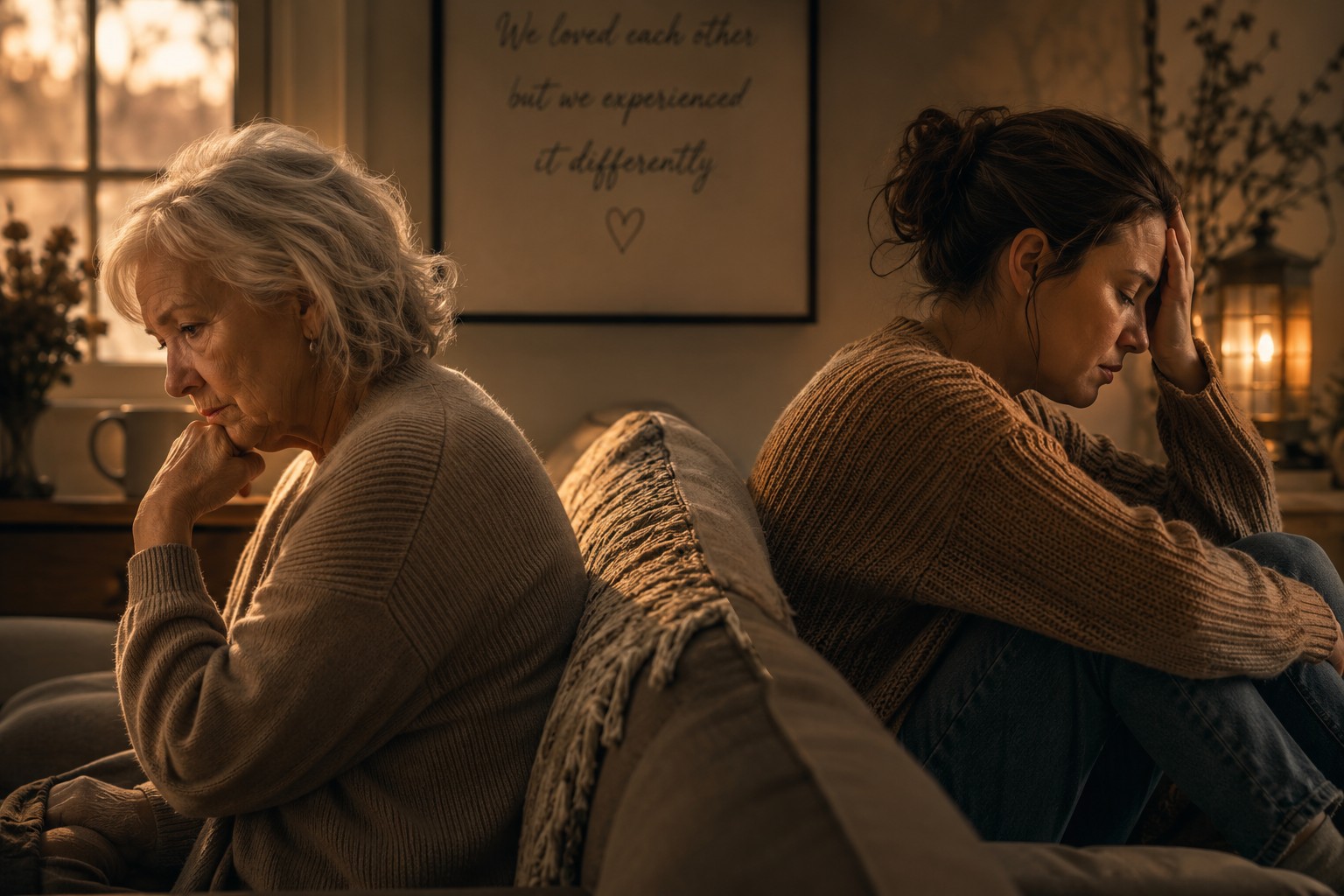
This one is for the parents sitting in silence, wondering how everything they poured into their children somehow ended up here in expectation of Accountability.
It’s also for the adult children carrying hurts they cannot seem to put down—who have wondered if their parents will ever truly understand what growing up felt like from their side.
If you’re reading this hoping to prove someone wrong, this article probably isn’t for you.
But if you’re reading because you genuinely want to understand how two people can love each other deeply and still experience the same family so differently… I hope you’ll stay.
My hope isn’t to convince either side that they’re right. It’s to invite both sides to become curious enough to ask a different question:
Is it possible that we loved each other… but experienced that love differently?
Because healing doesn’t begin when one person finally admits they’re wrong. It begins when two people become curious enough to ask how they could have lived the same story… and walked away with two different truths.
“But I Did Show Up”
There are parents out there who still showed up. The ones who went to work, paid the bills, and put food on the table—even when they did not know how they were going to make it all work.
Parents who said yes whenever they could and felt guilty when they could not. The ones who tried to be everything at once: provider, protector, teacher, disciplinarian, emotional support, and safe place, all while attempting to hold themselves together behind the scenes.
And now?
Some are being told they were not enough.
Others are not being told anything at all.
There is only distance. Silence. No contact. Questions left unanswered and conversations that never seem to happen.
It hurts in a way that is difficult to explain because you are left sitting there, replaying the years in your mind and asking yourself:
“I did everything I thought I was supposed to do. How did it end like this?”
Let us say something out loud that needs to be said:
You were never meant to be perfect.
There is no version of parenting in which every decision lands perfectly, every word is received exactly as it was intended, and every child reaches adulthood without carrying some kind of hurt.
That was never the assignment.
You were raising children while learning yourself. You were managing stress, navigating relationships, working through financial pressure, carrying responsibilities most people never saw, and often confronting wounds from your own childhood at the same time.
You were doing the best you could with what you knew and what you had available to you then.
That does not mean every choice was right.
It does not mean there are no conversations to revisit or apologies to offer.
It means you were human.
And that matters.

The Lesson Many of Us Never Knew We Had to Teach
Many of us became the parents we desperately needed when we were children.
We loved fiercely. We protected. We sacrificed. We rearranged our lives, anticipated needs, worried through sleepless nights, and tried to make sure our children never questioned whether they were loved.
We wanted them to feel safe, supported, accepted, and encouraged because many of us understood what it felt like to grow up without those things.
So we gave.
Then we gave a little more.
We worked long hours. We rescued. We solved problems. We absorbed disappointment. We placed ourselves last because somewhere along the way we accepted the idea that this was simply what a good parent was supposed to do.
We gave until they became entitled to our energy.
That sentence may feel uncomfortable, but discomfort does not automatically make something untrue.
I am not saying our children consciously decided to become entitled. I am not saying we intentionally raised them to be inconsiderate. I am saying that human beings learn what relationships are supposed to look like through repetition.
If Mom is always available, always says yes, always rearranges her life, always makes the call, always initiates the visit, always forgives the absence, and always carries the disappointment quietly, then eventually that becomes normal.
It becomes the relationship as they understand it.
Not because our children sat down and decided to take advantage of us, but because no one taught them that the relationship would eventually need to change.
Most of us taught our children how to say please and thank you. We taught them how to share, how to apologize, how to care about the feelings of their friends, and how to become responsible members of a family or community.
But how many of us consciously taught them how to participate in a healthy relationship with us once they became adults?
Not when they were seven.
Not when they were twelve.
When they were twenty-five, thirty, or forty.
Children spend much of their early lives receiving love, guidance, patience, protection, forgiveness, and sacrifice. That is appropriate. They are children.
However, as they grow into adults, another lesson must slowly emerge: the people who raised them are not only parents.
They are people.
People who become tired.
People who feel lonely.
People who still need encouragement.
People who deserve kindness and consideration.
People who want to feel remembered, valued, and chosen sometimes too.

Love is not a debt our children owe us because we raised them. Healthy reciprocity is not repayment, obligation, or scorekeeping.
It is the natural evolution of a relationship between two adults.
There is a difference between saying, “I raised you, so now you owe me,” and saying, “If we are going to have an adult relationship, both of us must eventually care about how the other person experiences it.”
Many loving parents unintentionally missed this lesson because they were so focused on making sure their children never questioned their love.
We wanted them to know they could always come home.
Always call.
Always ask for help.
Those are beautiful gifts.
But perhaps, in offering unconditional love, some of us failed to explain that unconditional love does not mean unlimited access, endless emotional labor, or a relationship in which only one person is expected to show up.
For many of us, this became even more complicated because of the homes in which we were raised.
Some of us were taught to honor our parents simply because they were our parents, even when love, emotional safety, or genuine support were absent. When we had children of our own, we swung as far as possible in the opposite direction.
We decided our children would never feel the way we did.
They would never have to earn affection.
They would never question whether they mattered.
They would never be afraid to call home.
That decision came from love.
But while protecting our children from the pain we experienced, some of us may have forgotten to teach them that honoring a loving parent is not the same thing as blind obedience.
It means recognizing the humanity of the person who spent years recognizing theirs.
This is not about blaming parents or condemning adult children.
It is about acknowledging that perhaps there was an important lesson about relationships that many of us never knew we needed to teach.
Becoming a Student of Your Child
There is another part of this conversation that deserves just as much attention.
It is not enough to teach our children how to reciprocate. As parents, we must also learn how to truly listen to what our children are trying to tell us.
Not merely listen to their words while preparing our defense.
Not listen only through the lens of what we intended.
We must attempt to understand what they actually experienced.
I recently learned something important through a conversation with my own son.
He told me:
“You put all this pressure on me to succeed.”
At the time, I could not understand his statement.
From my perspective, I had never told him that he must win. I had never demanded that he receive all A’s. I did not believe I had placed perfection on his shoulders.
In fact, I thought I had done the opposite.
I remember taking him bowling for the first time. I was already on a bowling league, so I knew how to bowl. He was learning for the first time. Naturally, I won without putting much effort into it because I was not there to compete with him. I was there to have fun.
He became upset and wanted to continue bowling until he could beat me.
I told him:
“Honey, it is okay that you are not perfect yet. It takes time and practice to get there. We can come back more often if you would like to get better.”
That sounds harmless, does it not?
Encouraging, even.
When he brought home report cards with A’s, B’s, and perhaps the occasional C, I thought he had done well. When he became disappointed that the grades were not better, I reminded him that perfection was not the name of the game. I told him I was proud of him.
Through my own lens, I was trying to remove pressure.
I wanted him to know that his worth was not dependent upon winning, outperforming everyone around him, or bringing home flawless grades.
What I did not stop to consider was what he may have been perceiving in those moments through the scope of his own experience.
My son had told me in different ways, even when he was young, that he needed perfection from himself.
Looking back now, I believe part of that may have been connected to his father not being consistently available throughout his childhood. A child cannot always explain the ache created by an absent parent. Sometimes that ache becomes a drive to be better, achieve more, or prove oneself worthy of being noticed.
I did not understand that at the time.
When I told him, “You do not have to be perfect,” what I meant was:
“I already love you. You are already enough.”
But through his own emotional language, he may have heard:
“I am proud of you for being just okay.”
Those are two very different messages.
Because he already expected perfection from himself, my attempts to reassure him may have unintentionally made his accomplishments feel mundane. He may have felt compelled to pursue even higher levels of perfection in hopes of receiving the reaction he believed he needed from me.
And I was not giving him that reaction—not because I did not care, but because I believed loving him meant teaching him that achievement did not determine his worth.
Neither of us was trying to harm the other.
I was speaking through the lens of the child I had once been and the mother I believed he needed.
He was listening through the lens of his own experiences, fears, and unmet emotional needs.
It was not my fault.
It was not his fault.
It was a lesson neither of us knew existed.
I was never taught to learn his heart and emotional language while also parenting him through my own values. I was never taught that loving a child is not only about offering the love I wish I had received. It is also about becoming curious enough to understand how that particular child recognizes and experiences love.

As parents, we naturally see our children through the lens of our own childhoods, wounds, hopes, and fears. We often attempt to become the parent we needed.
There is nothing shameful about that.
However, there is an important question we may need to ask:
What does my child actually need from me?
- Not what I would have needed at that age.
- Not what makes the most sense to me.
- Not what I intended them to hear.
What does this child, with this personality, this temperament, this history, and this particular heart, need in order to feel seen?
Sometimes the greatest gift we can give our children is not another lesson.
Sometimes it is the humility to become a student of theirs.
Maybe healthy parenting is not only about teaching our children how to love, communicate, and reciprocate. Maybe it is also about learning how they experience being loved in the first place.
And this is where the conversation becomes uncomfortable.
When Intention and Experience Are Different
Our adult children have feelings about their childhood experiences.
Those feelings are real to them.
We may not remember an event the same way. We may know what we intended. We may remember the context, the pressures we were carrying, or the difficult choices surrounding a particular moment.
But our children experienced those moments through their own developing minds and emotional worlds.
That experience deserves to be heard.
At the same time, feelings are not always the full truth.
Feelings are shaped by perception, interpretation, emotional state, age, memory, and sometimes incomplete understanding. This is not unique to adult children. It is true for every human being.
The problem begins when feelings are treated as final conclusions, irrefutable proof of wrongdoing, or unquestionable justification for completely cutting another person off.
Feelings are not verdicts.
They are information.
Yes, your child may feel hurt.
They may feel misunderstood.
They may believe that you were not enough for them in certain moments.
Listening to that does not mean you must agree with every interpretation. It does not mean you were a terrible parent, that you failed completely, or that everything you did was wrong.
It means there is something in their experience that deserves curiosity.
A parent should be able to say:
“I may not remember it the way you do, but I want to understand how it felt for you.”
An adult child should also be able to consider:
“My feelings are real, but perhaps I did not understand everything my parent was carrying at the time.”
Both statements can exist together.
We do not have to erase intention in order to honor impact.
We also do not have to erase impact in order to recognize intention.
Two people can live through the same family, the same home, and even the same event, yet walk away carrying completely different stories.
That does not necessarily mean one person is lying and the other is telling the truth.
It means each person experienced life from a different position inside it.
Parents Are Allowed to Have Boundaries Too
Parents are allowed to acknowledge their adult child’s hurt without allowing their entire identity to be reduced to that hurt.
You are allowed to say:
“I hear that you are hurting, and I am willing to examine the ways I contributed to that pain. But I cannot accept being defined only by the moments in which I failed you.”
You are allowed to recognize:
“I made mistakes, but I also showed up every day.”
There is an increasingly common expectation that parents should have gotten everything right, met every emotional need perfectly, and somehow raised completely different children in exactly the same way without either child ever feeling misunderstood.
That is not merely unrealistic.
It is unfair.
One child may need encouragement while another experiences the same encouragement as pressure. One may need space while another experiences that space as abandonment. One child may remember a parent as deeply involved, while another remembers that same parent as controlling.
Parenting is not a fixed formula.
Children are individuals. Parents are individuals. Families are living systems made up of people with different needs, wounds, perceptions, and emotional languages.
A parent can listen, reflect, apologize, and change without accepting responsibility for every emotion another adult experiences.
There is a difference between accountability and self-erasure.
Accountability says:
“I am willing to look honestly at what I did.”
Self-erasure says:
“Your pain proves that everything about me was wrong.”
Those are not the same thing.

Accountability Does Not Stop at Childhood
There is another part of this conversation that does not receive enough attention.
Accountability does not end with the parent.
When children become adults, they are no longer only reacting to the world created around them. They are also making choices about how they interpret their past, how they communicate their needs, whether they seek understanding, and how they participate in their current relationships.
This does not mean childhood wounds disappear the moment someone turns eighteen.
It does not mean trauma should be dismissed or that an adult child must remain in a relationship that is unsafe, abusive, or consistently harmful.
It means adulthood eventually asks all of us to examine not only what happened to us, but also what we choose to do with what happened.
There comes a point in every healthy parent-and-adult-child relationship when both people begin carrying responsibility for the relationship.
Parents do not stop being parents, but adult children are no longer simply children. They become active participants in whether the relationship grows, heals, remains stagnant, or drifts apart.
That is not about assigning equal blame for every wound.
It is about recognizing that no healthy adult relationship can remain one-sided forever.
Sometimes an adult child may choose distance. In certain situations, distance may be necessary. Boundaries can be healthy and protective.
But distance without communication, conversation, or any attempt to bridge understanding does not automatically create healing.
Sometimes it creates avoidance.
Avoidance may provide temporary relief, but relief and healing are not always the same thing.
Avoidance does not create clarity.
Often, it simply creates more separation.
Feelings Matter, but They Cannot Become Accusations
Here is a simple way to understand the distinction.
I may feel lonely because my husband is at work.
My loneliness matters. It is real. It may tell me that I need more connection, reassurance, companionship, or intentional time together.
However, I do not get to turn that feeling into the accusation:
“You are failing me because I feel lonely.”
My husband is at work because we have responsibilities. Life requires effort, and showing up sometimes means doing what needs to be done rather than what feels best in the moment.
My feelings deserve attention.
They do not automatically prove his wrongdoing.
The same principle applies within relationships between parents and adult children.
An adult child cannot reasonably declare that a parent was both too involved and never present, too controlling and not attentive enough, too emotional and emotionally unavailable, without eventually acknowledging the complexity of parenting and the contradictions that may exist within their own experience.
That does not mean the feelings beneath those statements are invalid.
It means the feelings need to become the beginning of a conversation, not the final prosecution of another person.
Most parents—especially the ones who will recognize themselves in this article—were not attempting to harm their children.
They were trying to hold everything together.
Sometimes they got it wrong.
Sometimes they reacted from fear.
Sometimes they repeated patterns they swore they would never repeat.
Sometimes they failed to understand what their children were trying to communicate.
But many also worked, sacrificed, protected, encouraged, worried, and loved with everything they knew how to give.
Both truths deserve room.
The Space Between Two Truths
You are allowed to know that you did the best you could.
Not perfectly.
But honestly.
You are also allowed to recognize that doing your best does not mean your child never felt pain.
Those truths do not cancel one another.
If your child is currently in a place where they cannot recognize your effort, that does not erase the love you gave.
It may simply mean they are still working through their own process.
Just as you are working through yours.
Perhaps there is still a space somewhere in the middle where both truths can exist.
Not as a fight.
Not as a verdict.
Not as a competition over who suffered more.
But as an opportunity to say:
“We experienced the same family differently.”
Maybe the parent can say:
“I did not understand what you needed from me then, but I want to understand now.”
Maybe the adult child can say:
“I was hurt by what I experienced, but I am willing to consider that you were doing more than I could see.”
That does not have to mean the end of the relationship.
But it does mean something must change.
Not perfection.
Perspective.
The Part No One Wants to Talk About
I cannot be both too much and not enough at the same time.
I cannot be expected to take full accountability for how someone else feels while being told that my own hurt does not matter.
I have apologized.
I have reflected.
I take responsibility for not always getting it right—not because I was supposed to be perfect, but because I am human. I would never intentionally hurt the people I love, and the truth is that none of us were ever meant to get parenting completely right.
But I cannot be the only person calling, showing up, reaching out, and trying.
I cannot be expected to beg for time and then be told I did not ask often enough.
I cannot be told to respect someone else’s boundaries while my own boundaries are treated as rejection.
That is not healing.
That is a double standard.
I am not a superhero.
I may wear a cape, but that same cape can be used to drag me back into patterns I have already outgrown. It can pull me back into believing that love requires proving my worth, shrinking myself to remain acceptable, or carrying the entire emotional weight of a relationship alone.
That is not love.
That is imbalance.
Love may be unconditional, but relationships require participation.
They require communication.
They require consideration.
They require the willingness to listen, repair, and see the humanity on both sides.
And to the parents sitting in this same space—feeling confused, overwhelmed, and exhausted from trying—I see you.
You are not wrong for wanting connection.
You are not wrong for feeling hurt.
You are not wrong for examining the past and acknowledging where you could have done better.
You are also not wrong for realizing that you cannot continue doing all the work alone.
Real healing requires both people.
It requires parents who are willing to listen beyond their intentions and adult children who are willing to look beyond their pain.
It requires parents to teach reciprocity and also become students of their children’s hearts.
It requires accountability without humiliation, boundaries without punishment, and compassion without self-abandonment.
Until both people are ready to participate, you are allowed to stop chasing.
Not out of anger.
Not out of spite.
Not because you no longer love them.
But because you are finally learning that you are a person inside this relationship too.
And that is not selfishness.
It is self-respect.
Before You Go…
If you’ve made it all the way to the end of this article, thank you.
Whether you found yourself relating more as the parent, the adult child, or somewhere in between, my hope is that you leave with one simple thought:
Maybe understanding begins when we become curious enough to see the story through someone else’s eyes.
Everything I write here at Heather’s Fireside is created with that hope in mind.
If this article resonated with you, I invite you to spend a little more time around the fire. There are other articles waiting for you that dive deeper into topics like people-pleasing, giving away our power, living under the weight of other people’s expectations, and learning how our childhood experiences continue to shape our adult relationships.
And if this article brought you comfort, challenged your perspective, or helped you feel just a little less alone, I have one small favor to ask.
Heather’s Fireside exists because I believe these conversations matter. Every article is researched, reflected on, written, revised, and shared with the hope that someone, somewhere, feels seen enough to begin healing.
If you’d like to help keep this work flowing, growing, and freely available to others, I would be incredibly grateful if you considered making a donation.
No amount is too small, and there is never any expectation.
Your support simply helps me continue creating articles, resources, and a place where people can gather—not to judge one another, but to understand one another.
Whether you choose to donate, continue reading, or simply carry one new perspective with you today…
Thank you for spending a little time by the fire with me.
With gratitude,
Heather Malloy
Heather’s Fireside 💜

Leave a Reply